
Quick Answer: “Advice” is a noun (a thing). “Advise” is a verb (an action). The S sound in “advice” matches the noun. The Z sound in “advise” matches the verb.
Many people confuse these two words. They sound almost the same. But they mean different things. One is a thing. One is an action. Learning the difference helps you write correctly. It helps you speak correctly too.
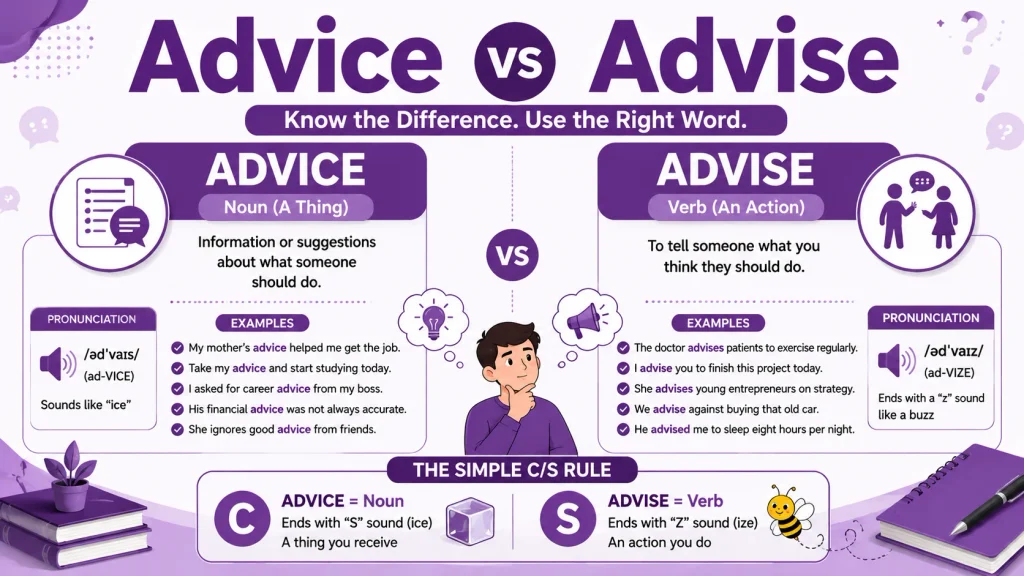
Quick C/S Rule – Difference at a Glance
This simple rule helps you remember forever:
| Word | Type | Sound | Meaning | Example |
|---|---|---|---|---|
| Advice | Noun | S sound (ice) | A thing you receive | “Give me your advice.” |
| Advise | Verb | Z sound (ize) | An action you do | “Please advise me.” |
Remember this:
- Advice = noun → ends with S → sounds like “ice”
- Advise = verb → ends with Z → sounds like “ize”
This pattern shows up in other words too. We show you those later.
When to Use “Advice” (Noun)
“Advice” is a noun. It is a thing. It means information or suggestions about what someone should do.
Advice Definition & Pronunciation
How to say it: /ədˈvaɪs/ (ad-VICE)
Say the word slowly. The “ai” sound is long. It rhymes with “rice” and “nice.” Think of ice cream. Both “advice” and “ice” end with the same sound.
Example: My teacher gave me good advice about studying.
(In this sentence, “advice” is a thing. You can get it. You can use it. You can follow it.)
5 Real Examples of “Advice”
- My mother’s advice helped me get the job. (She gave me suggestions. I listened to her ideas. The suggestions were helpful.)
- Take my advice and start studying today. (Listen to my suggestions. Do it now. Don’t wait.)
- I asked for career advice from my boss. (I wanted guidance about my job. I needed suggestions about my future.)
- His financial advice was not always accurate. (His suggestions about money were sometimes wrong. I did not trust all his ideas.)
- She ignores good advice from friends. (People give her helpful suggestions. She does not listen to them. She does what she wants.)
Common Phrases Using “Advice”
- Give advice → My doctor gives me advice about exercise every month.
- Take advice → You should take advice from experienced people.
- Seek advice → I seek advice when I face problems.
- Follow advice → If you follow advice, you improve faster.
- Ask for advice → Students ask for advice before choosing their major.
- Receive advice → I receive advice from my parents regularly.
- Offer advice → Teachers offer advice to help students succeed.
Important Grammar Note: “Advice” is Uncountable
“Advice” is an uncountable noun. Do not say “an advice” or “advices.”
Wrong sentence:
- Wrong: “He gave me an advice.”
- Wrong: “I received two advices from my teacher.”
Right Sentence:
- Right: “He gave me a piece of advice.”
- Right: “I received two pieces of advice from my teacher.”
- Right: “I received some advice from my teacher.”
Examples:
- “A piece of advice: study every day.” (one item)
- “Some advice: start early and work hard.” (multiple items)
- “The advice I got was helpful.” (uncountable)
When to Use “Advise” (Verb)
“Advise” is a verb. It is an action. It means to tell someone what you think they should do.
Advise Definition & Pronunciation
How to say it: /ədˈvaɪz/ (ad-VIZE)
The “ai” sound is long. Like “ice.” But the end has a Z sound. Listen carefully. The Z sound is very small. But it is important.
Think of a bee buzzing. “Advise” ends with a Z sound. Like a buzz.
Example: I advise you to drink more water every day.
(In this sentence, “advise” is an action. You are doing something. You are telling someone what to do.)
5 Real Examples of “Advise”
- The doctor advises patients to exercise regularly. (He tells them what to do. They should exercise. This is what he thinks is best.)
- I advise you to finish this project today. (This is my suggestion. You should complete it now. This is what I think you should do.)
- She advises young entrepreneurs on business strategy. (She gives guidance to new business owners. They ask her for help. They want her suggestions.)
- We advise against buying that old car. (Do not buy it. We think it is a bad choice. We suggest something different.)
- He advised me to sleep eight hours per night. (He gave me this suggestion in the past. I should sleep this much. This was his advice.)
Common Patterns Using “Advise”
Pattern 1: Advise someone to do something
- She advises her students to read more books.
- The lawyer advises clients to sign the contract.
Pattern 2: Advise against something
- I advise against traveling during that time.
- Doctors advise against smoking completely.
Pattern 3: Advise on something
- She advises on website design for small businesses.
- He advises on tax planning for companies.
Adviser vs Advisor
Both spellings are correct. But they are used differently. Below table shows the difference between Adviser and Advisor:
| Spelling | Usage | Common Fields | Example |
|---|---|---|---|
| Adviser | Standard in UK and general writing | Academic, general use | “She is an adviser in education.” |
| Advisor | More common in formal titles in US | Business, legal, finance | “He works as a Financial Advisor.” |
Important: Both are correct. Use “adviser” in British English or when writing generally. Use “advisor” when you see it in official titles.
Examples:
- “The financial adviser helped me plan my retirement.” (British style)
- “I hired a Financial Advisor for my business.” (American formal title)
- “She is a trusted adviser to the company.” (General use)
- “He is an Academic Advisor at the university.” (Official title)
Struggling with other tricky word pairs? Check out our guide on Affect vs Effect to master even more commonly confused English words.
“Advisable” & “Advisory” (More Related Words)
These words come from “advise” and “advice.” They are adjectives and nouns.
Advisable (Adjective)
“Advisable” means something is a good idea. You should do it.
Examples:
- It is advisable to wear a seatbelt in the car.
- The doctor said it is not advisable to exercise when sick.
- It is advisable to arrive early for the interview.
Advisory (Adjective & Noun)
“Advisory” means it gives advice or information.
Examples:
- A weather advisory warns people about storms. (noun)
- She works in an advisory role for the company. (adjective – she gives advice)
- The travel advisory warns tourists about that area. (noun – information about travel)
Pronunciation & Sound Memory Trick
The ending sound is the key difference. Listen carefully.
S = Snake Sound (Advice)
Think of a snake. It makes a long “ssssss” sound.
- “Advice” ends with S.
- It sounds like: /ədˈvaɪs/
- S = Snake = “ssss” sound
Say it: “ad-VICE” (the final S sound, like “ice”)
Z = Buzz Sound (Advise)
Think of a bee. It makes a buzzing “zzzz” sound.
- “Advise” ends with Z.
- It sounds like: /ədˈvaɪz/
- Z = Bee = “zzzz” sound
Say it: “ad-VIZE” (the final Z sound, like a buzz)
Practice This Right Now
Listen carefully:
- Say “ice cream” – notice the S sound at the end
- Say “advice” – it ends the same way
- Say “advise” – the Z sound is different
- Say them together: “advice, advise, advice, advise”
The sound is small. But it is important for correct pronunciation.
10 Real Sentences Using Advice and Advise Words
These sentences show how to use each word correctly. Read them carefully.
- I advise you to take my advice about health. (First action. Then thing. The sentence makes sense.)
- Her advice was helpful, and I followed what she advised. (First the thing. Then the action. Both correct.)
- Before you advise anyone, ask for advice yourself. (First action. Then thing. Shows the connection.)
- The consultant advised me to trust her previous advice. (Action in past. Then the thing. Professional context.)
- Don’t ignore advice when someone advises you seriously. (First thing. Then action. Shows importance.)
- My teacher advises students daily, and her advice always works. (First action. Then thing. Regular pattern.)
- I advise against bad advice from unreliable sources. (First action. Then thing. Negative example.)
- When you advise others, share advice you have tested. (First action. Then thing. Practical wisdom.)
- She advised me against following outdated advice online. (Action in past. Then thing. Modern context.)
- Good advice comes from people who advise based on experience. (First thing. Then action. Quality marker.)
Quiz: Test Your Knowledge
Answer these 6 questions. Check your understanding.
Question 1: Which word is a noun?
- A) Advise
- B) Advice
- C) Both
Answer: B – Advice is the noun. Advise is the verb.
Question 2: Complete the sentence: “I _____ you to study more.”
- A) Advice
- B) Advise
- C) Advices
Answer: B – Advise is the verb. You advise someone.
Question 3: Which sentence is correct?
- A) “She gave me a good advise.”
- B) “She gave me good advice.”
- C) Both are correct.
Answer: B – Advice is the noun. You don’t use “advises” here. Advice is uncountable.
Question 4: What does “advise” mean?
- A) Information or suggestions
- B) To suggest what someone should do
- C) A noun that you can count
Answer: B – Advise is a verb. It means to suggest or tell someone.
Question 5: Choose the right answer: “The _____ was _____ by experts.”
- A) advice, advise
- B) advise, advice
- C) advice, advised
Answer: C – Advice is the noun. Advised is the past form of advise (the verb).
Question 6: Which phrase is correct?
- A) “Take my advise”
- B) “Take my advice”
- C) “Take my advices”
Answer: B – Advice is uncountable. You don’t add “s.” You say “advice” for one or many.
FAQs
Can I use “advise” as a noun?
No. In standard English, “advise” is only a verb. Very old texts use it as a noun. But modern English does not do this.
What about plural “advices”?
“Advice” is uncountable. You cannot say “advices” in normal English. You say “pieces of advice” or just “advice” (the same for one or many).
How do native speakers remember this?
They learn it as children. After years of reading and speaking, it becomes automatic. You can reach this level too with practice.