
Quick Answer:
Affect = Verb (an action). Effect = Noun (a result). There is one exception for each word, and we cover both below.
Example:
- The rain affects my mood. (verb, an action)
- The rain has a bad effect on my mood. (noun, a result)
Do you stop and think every time you write “affect” or “effect”? You are not alone. Millions of English learners, and even native speakers, mix up these two words every day.
I have taught English for many years. In that time, I have graded thousands of student essays. “Affect” and “effect” are one of the most common mistakes I see, even from advanced students.
The good news is this: the rule is simple once you see it clearly. This guide gives you the exact difference, 25 real examples, memory tricks, and a quick quiz at the end.
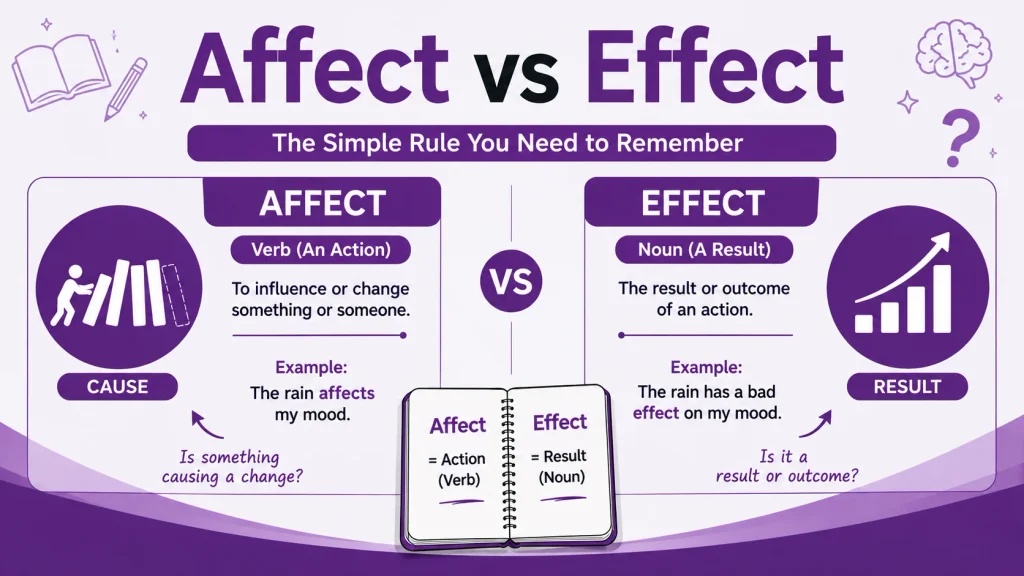
Affect vs Effect Comparison
| Word | Part of Speech | Meaning | Example |
|---|---|---|---|
| Affect | Verb (common) | To influence or change something | The news affected her mood. |
| Affect | Noun (rare, psychology) | Visible emotional expression | The patient showed a flat affect. |
| Effect | Noun (common) | A result or outcome | The effect of the storm was major flooding. |
| Effect | Verb (rare, formal) | To cause something to happen | The team plans to effect change soon. |
What Does “Affect” Mean? (When to Use Affect)
“Affect” is usually a verb. It means to influence something or someone, or to change them in some way.
Example: Loud noise affects my sleep. Here, the noise causes a change, so “affect” works as the action word.
In my classroom, I tell students to ask one question first: “Is something causing a change?” If yes, the word is almost always “affect.”
Pronunciation
Affect sounds like: /əˈfekt/, written simply as uh-FEKT. The stress falls on the second part of the word, “FEKT,” not the first.
Say it out loud a few times. Notice how the first sound is soft, almost like “uh.” This small detail helps you separate it from “effect” when you hear both words in a sentence.
5 Example Sentences
- Stress can affect your health. (Stress is the cause; health changes as a result.)
- Her speech affected the whole audience. (Her words changed how people felt.)
- Smoking affects your lungs badly. (Smoking causes damage over time.)
- The new law will affect small businesses. (The law will change how they operate.)
- Poor sleep affects your focus at work. (Lack of sleep changes your concentration.)
Memory Trick: “A” = Action (Verb)
Here is an easy way to remember it:
- Affect starts with A.
- Action also starts with A.
- Affect is an action word, so it is a verb.
Example: The storm will affect flight schedules tomorrow. Ask yourself: is the storm doing something? Yes, so use “affect.”
I use this trick with beginner students, and it works almost every time. The letter match makes the rule stick faster than a long grammar explanation.
What Does “Effect” Mean? (When to Use Effect)
“Effect” is usually a noun. It means the result or outcome of an action.
Example: The medicine had a fast effect on my headache. Here, “effect” names the result of taking the medicine, not an action itself.
A simple test: try adding “the” or “an” before the word. “The effect” sounds correct because effect is a thing, a result. You cannot naturally say “the affect” in most sentences, because affect is normally an action, not a thing.
Pronunciation
Effect sounds like: /ɪˈfekt/, written simply as ih-FEKT. It looks close to “affect,” but the first sound is sharper, more like a short “ih.”
Many of my students struggle to hear the difference at first. Practice saying both words back to back: “uh-FEKT, ih-FEKT.” Over time, your ear will catch the small gap between them.
5 Example Sentences
- The new policy had a positive effect on sales. (Sales went up as a result.)
- Side effects of this drug include headaches. (Headaches are a result of taking the drug.)
- His words had a strong effect on the team. (The team’s mood or actions changed because of what he said.)
- The effect of climate change is visible everywhere. (Climate change causes visible results, like floods and droughts.)
- Sound effects made the movie more exciting. (The sounds added to the movie are results created by the sound team.)
Memory Trick: “E” = End Result (Noun)
Try this trick:
- Effect starts with E.
- End result also starts with E.
- Effect is the end result, so it is a noun.
Example: The effect of the price cut was more customers. Ask yourself: am I talking about a result? Yes, so use “effect.”
When Is Affect a Noun?
In psychology, “affect” can work as a noun. It means a person’s visible emotional state, such as their facial expression, tone of voice, or body language.
Doctors, nurses, and therapists use this word often in medical notes. A patient can show a “flat affect,” which means they show little to no emotion on their face, even in a stressful moment.
I once worked with a student who was training to become a nurse. She asked why her textbook used “affect” as a noun. This medical use was the reason, and it confuses many learners because it breaks the usual rule.
2 Examples
- The doctor noted the patient’s flat affect during the interview.
- Her affect seemed calm, even though she felt nervous inside.
This use is common in medical and psychology reports. You will rarely need it in daily writing, emails, or general essays.
When Is Effect a Verb?
“Effect” can also work as a verb, but only in formal writing. It means to make something happen or to bring about a result directly.
The most common phrase is “effect change.” It means to cause change to happen, often through direct action or authority.
This exception trips up even confident writers. In business writing, “effect” as a verb usually appears in reports, policy documents, or speeches about leadership and reform.
Examples
- The new manager wants to effect change in the sales team.
- Leaders must effect real reform, not just talk about it.
This use is rare in daily speech. You mostly see it in business, law, and government writing, so you rarely need to use it yourself.
15 More Affect vs Effect Examples in Real Life
Real examples help the rule stick in your memory. Here are 15 more from three common writing situations. I picked these settings because my students meet “affect” and “effect” most often in news, work emails, and school papers.
In News Headlines
- “New Tax Law Affects Millions of Workers” — the law changes people’s income, so it is a verb.
- “Storm’s Effect on Local Farms Still Unclear” — the result of the storm is the noun here.
- “Study Shows Social Media Affects Teen Mental Health” — social media causes a change, so it is a verb.
- “Government Policy Has Long-Term Effect on Economy” — the result on the economy is the noun.
- “Heatwave Affects Power Supply Across the City” — the heatwave causes a change in power supply.
In Business Emails
- “This change will affect our delivery timeline.” — the change causes a shift in timing.
- “Please review the effect of this update on our budget.” — the result on the budget is the noun.
- “The new software affects how we track sales.” — the software changes the tracking process.
- “We expect a positive effect on customer satisfaction.” — the result is positive, so it is a noun.
- “The delay will affect next week’s meeting schedule.” — the delay causes a change in the schedule.
In Academic Writing
- “The study examines how sleep affects memory.” — sleep changes memory, so it is a verb.
- “Researchers measured the effect of diet on heart health.” — the result of diet is the noun.
- “This factor did not affect the final results.” — the factor caused no change.
- “The effect size was small but still meaningful.” — “effect size” is a common noun phrase in research papers.
- “Temperature can affect the speed of a chemical reaction.” — temperature causes a change in speed.
Affect vs Effect Quiz: Test Yourself (5 Questions)
Try this short quiz. Pick the correct word for each sentence, then check your answer below.
- The new rules will _____ how we work. a) affect b) effect
- The medicine had a strong _____ on his pain. a) affect b) effect
- Doctors want to _____ change in patient care. a) affect b) effect
- Her calm _____ surprised the interviewer. a) affect b) effect
- Poor internet speed can _____ your work. a) affect b) effect
Answers:
- a) affect — the rules cause a change in how you work.
- b) effect — the pain relief is the result of the medicine.
- b) effect — this is the rare “effect change” verb use.
- a) affect — this is the rare psychological noun use.
- a) affect — poor speed causes a change in your work.
How many did you get right? If you got 4 or 5, you have a strong grasp of the rule. If you missed a few, read the exception sections again. Those two rare cases cause most of the confusion, even for experienced writers.
Still Mixing Up Affect and Effect? Remember This
If the quiz felt hard, try the RAVEN trick. Teachers and grammar guides use it often because it is short and easy to recall:
- Remember:
- Affect =
- Verb
- Effect =
- Noun
In short: Affect is usually the action (verb). Effect is usually the result (noun). Read your sentence again and ask, “Am I talking about an action, or a result?” That answer tells you which word to use.
In my own classes, students who use RAVEN make far fewer mistakes within just one or two weeks. Keep this guide close. Over time, the choice between affect and effect will feel automatic, and you will stop pausing mid-sentence to check.