
Credit card statements are full of words that sound confusing at first. APR, grace period, hard inquiry — these terms decide how much you pay and how your credit score moves. Once you know what they mean, a credit card stops feeling like a trap and starts working as a tool.
This guide covers 50 credit card terms. Each one has a short, simple meaning. No bank jargon. No long paragraphs. Just facts you can use the next time you read a statement, compare two cards, or apply for a new one.
Rates, fees, and reward structures vary by bank and by country. So this guide explains what each term means everywhere, not one bank’s specific numbers. Always check your own card’s terms and conditions for exact figures.
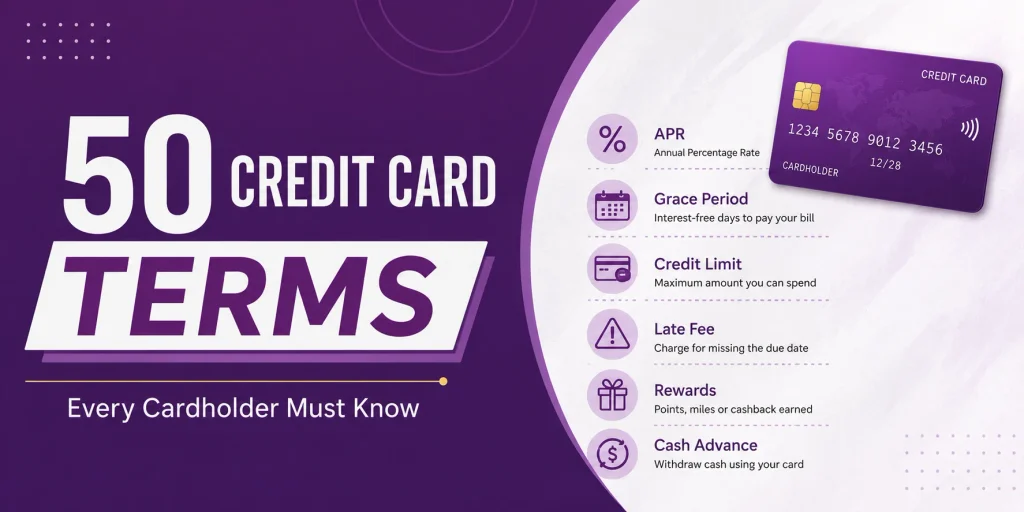
Credit Card Terms and Meaning
The following table show the 50 important credit card terms and definition that every cardholder must know:
| # | Term | Meaning | Where You Use It |
|---|---|---|---|
| 1 | Cardholder | Person who owns and is responsible for the card | On the card agreement and every statement |
| 2 | Card Issuer | Bank that gives you the card | Sets your limit, rate, and statement |
| 3 | Card Network | Company that moves the payment (Visa, Mastercard, etc.) | Shown on the card logo |
| 4 | Credit Limit | Highest amount you can spend | Checked before every purchase |
| 5 | Available Credit | Limit minus what you already owe | Shown in your app or statement |
| 6 | Billing Cycle | The days covered by one statement | Decides which purchases appear together |
| 7 | Statement | Monthly summary of your account | Sent every month by email or app |
| 8 | Due Date | Last day to pay without a fee | Used to plan your payment |
| 9 | Grace Period | Days you get with no interest, if you pay in full | Helps you avoid interest charges |
| 10 | Minimum Payment | Smallest amount you must pay | Keeps your account in good standing |
| 11 | Current Balance | Total you owe right now | Checked anytime in your app |
| 12 | Statement Balance | What you owed at cycle end | Pay this in full to skip interest |
| 13 | Revolving Credit | Credit that refills as you repay | Describes how a credit card works |
| 14 | Autopay | Automatic bill payment | Set up once to avoid missed payments |
| 15 | APR | Yearly cost of borrowing, in percent | Compared when choosing a card |
| 16 | Fixed APR | Interest rate that stays the same | Used for stable monthly planning |
| 17 | Variable APR | Interest rate that can change | Moves with a benchmark rate |
| 18 | Introductory APR | Low rate for a limited time | Used for new cards or balance transfers |
| 19 | Penalty APR | Higher rate after a missed payment | Applied after breaking card rules |
| 20 | Cash Advance APR | Interest rate on cash withdrawals | Applied the moment you take cash out |
| 21 | Compound Interest | Interest charged on interest | Explains why unpaid debt grows fast |
| 22 | Annual Fee | Yearly charge for owning the card | Charged once a year, regardless of use |
| 23 | Late Payment Fee | Charge for missing the due date | Added after a missed payment |
| 24 | Over-Limit Fee | Charge for spending past your limit | Applied if the issuer allows over-limit spending |
| 25 | Foreign Transaction Fee | Charge for paying in another currency | Applied when shopping or traveling abroad |
| 26 | Balance Transfer Fee | Charge for moving debt to another card | Applied during a balance transfer |
| 27 | Cash Advance Fee | Flat charge for withdrawing cash | Added on top of cash advance APR |
| 28 | Returned Payment Fee | Charge when your payment fails | Applied if your bank payment bounces |
| 29 | Credit Score | Number showing your repayment reliability | Checked by lenders before approval |
| 30 | Credit Report | Full record of your credit history | Reviewed by banks and landlords |
| 31 | Credit Bureau | Company that builds your credit report | Collects data from banks and lenders |
| 32 | Credit Utilization Ratio | Balance compared to your total limit | Watched to protect your credit score |
| 33 | Hard Inquiry | Credit check after you apply for credit | Can slightly lower your score |
| 34 | Soft Inquiry | Credit check that doesn’t affect your score | Happens when you check your own report |
| 35 | Credit History | How long and how well you’ve used credit | Builds up over years of on-time payments |
| 36 | CVV | 3 or 4-digit security code on the card | Entered for online and phone payments |
| 37 | PIN | Private number for card transactions | Entered at ATMs and payment terminals |
| 38 | EMV Chip | Security chip embedded in the card | Used for safer in-person payments |
| 39 | Contactless Payment | Tap-to-pay without inserting the card | Used for quick, small purchases |
| 40 | Tokenization | Real card number replaced with a code | Used in mobile wallet payments |
| 41 | Chargeback | Reversal of a disputed payment | Requested when a charge is wrong or fraudulent |
| 42 | Card-Not-Present Transaction | Payment made without showing the card | Happens in online and phone orders |
| 43 | Fraud Alert | Notice about a suspicious transaction | Sent by SMS or app when fraud is suspected |
| 44 | Rewards Program | System that gives points or cashback | Earned automatically on your spending |
| 45 | Cashback | Reward paid back as real money | Credited to your statement or account |
| 46 | Sign-Up Bonus | One-time reward for new cardholders | Given after meeting a spending target |
| 47 | Redemption | Turning rewards into something usable | Done through the bank’s rewards portal |
| 48 | Authorized User | Person allowed to spend on someone else’s card | Added to an account without owning the debt |
| 49 | Delinquent Account | Account with a missed payment | Reported to credit bureaus after 30 days |
| 50 | Charge-Off | Debt written off after months of no payment | Recorded on your credit report for years |
Basic Credit Card Terms You See Every Day
These are the building blocks. You see these words on your card, your app, and your first statement.
1. Cardholder
The cardholder is the person named on the credit card. This person signs the agreement with the bank and takes legal responsibility for repaying the balance.
2. Card Issuer
The card issuer is the bank or financial company that gives you the card. It sets your credit limit, decides your interest rate, and sends your monthly statement.
3. Card Network
The card network processes the payment between the merchant and your bank. Visa, Mastercard, American Express, and Discover are the main networks. The network is different from the issuer:
- The issuer is your bank (say, HBL, Chase, or Barclays).
- The network is the payment rail (Visa or Mastercard) that connects your bank to the merchant’s bank.
4. Credit Limit
The credit limit is the maximum amount you can spend on the card. The issuer sets this limit based on your income, credit score, and repayment history.
5. Available Credit
Available credit is the amount left to spend after you subtract your current balance from your credit limit. If your limit is 100,000 and you owe 30,000, your available credit is 70,000.
6. Billing Cycle
The billing cycle is the period between two statement dates, usually around 28 to 31 days. Every purchase inside this window shows up on the same statement.
7. Statement
The statement is a monthly summary of your account. It lists every transaction, your total balance, your minimum payment, and your due date.
Payment and Balance Terms
These terms explain what happens after you swipe, tap, or spend online.
8. Due Date
The due date is the last day to pay your bill without a late fee. Payments made even one day after this date can trigger penalties and hurt your credit score.
9. Grace Period
The grace period is the time between the end of your billing cycle and your due date. If you pay your full statement balance within this window, most cards charge zero interest on new purchases.
10. Minimum Payment
The minimum payment is the smallest amount you must pay to keep your account in good standing. Paying only the minimum keeps the account active, but interest keeps building on the rest of the balance.
11. Current Balance
The current balance is the total amount you owe right now, including new purchases made after your last statement closed.
12. Statement Balance
The statement balance is the amount you owed at the end of the last billing cycle. This is the number you must pay in full to avoid interest charges during the grace period.
13. Revolving Credit
Revolving credit lets you borrow, repay, and borrow again without applying for a new loan each time. A credit card is the most common form of revolving credit. It works differently from a loan:
- A loan gives you a fixed amount once, and the balance drops as you repay.
- Revolving credit refills automatically as you pay down what you owe.
14. Autopay
Autopay is an automatic payment setup that pays your bill on the due date. You can set it to pay the minimum, the full statement balance, or a fixed amount.
Interest Rate and APR Terms
APR is the term that decides how expensive your debt becomes if you carry a balance.
15. APR (Annual Percentage Rate)
APR is the yearly cost of borrowing, shown as a percentage. It includes the interest rate and, in some cases, extra charges the issuer adds to the cost of credit.
16. Fixed APR
A fixed APR stays the same over time. It only changes if the issuer sends you advance notice, which most countries require by law.
17. Variable APR
A variable APR moves up or down based on a benchmark interest rate, such as a central bank’s base rate. Your monthly interest cost can rise even if your spending stays the same.
18. Introductory APR
An introductory APR is a low or 0% rate offered for a limited time, often 6 to 18 months, usually for new cardholders or balance transfers. Once the period ends, the standard APR applies.
19. Penalty APR
A penalty APR is a higher interest rate the issuer applies after you miss a payment or break the card agreement. It usually applies to your entire balance, not just new purchases.
20. Cash Advance APR
Cash advance APR is the interest rate charged when you withdraw cash using your credit card. This rate is almost always higher than your purchase APR, and interest often starts the same day, with no grace period.
21. Compound Interest
Compound interest means you pay interest on your interest, not just on the original amount you spent. This is why an unpaid credit card balance grows faster than most people expect.
Common Credit Card Fees
Fees are separate from interest. You can pay these even if you clear your balance every month.
22. Annual Fee
The annual fee is a yearly charge for owning the card, regardless of how much you use it. Premium cards with strong travel or cashback rewards usually carry higher annual fees.
23. Late Payment Fee
A late payment fee applies when you miss your due date. Many cards also raise your interest rate to the penalty APR after a late payment.
24. Over-Limit Fee
An over-limit fee applies when your spending crosses your approved credit limit. Some issuers block the transaction instead of charging this fee — the rule depends on the card and the country.
25. Foreign Transaction Fee
A foreign transaction fee applies when you pay in a currency other than your card’s home currency, both online and in person abroad. This fee usually runs between 1% and 3% of the transaction amount.
26. Balance Transfer Fee
A balance transfer fee applies when you move debt from one card to another, often to get a lower introductory APR. The fee is usually a percentage of the amount transferred.
27. Cash Advance Fee
A cash advance fee is a separate charge added on top of the cash advance APR every time you withdraw cash from your credit card.
28. Returned Payment Fee
A returned payment fee applies when your bank payment fails, for example due to insufficient funds in your linked account. This is different from a late payment fee, though both can apply at the same time.
Credit Score and Credit Report Terms
These terms decide whether banks approve your future applications and at what interest rate.
29. Credit Score
A credit score is a number that shows how likely you are to repay borrowed money. Lenders use it to decide whether to approve you, and what interest rate to offer.
30. Credit Report
A credit report is a detailed record of your borrowing history. It lists your open accounts, payment history, credit limits, and any missed payments.
31. Credit Bureau
A credit bureau is a company that collects data from banks and lenders to build your credit report and calculate your credit score. Different countries use different bureaus.
32. Credit Utilization Ratio
The credit utilization ratio compares your current balance to your total credit limit. A lower ratio usually helps your credit score. Most experts suggest keeping this ratio in a healthy range:
- Under 30% is generally considered safe for most scoring models.
- Under 10% often produces the strongest score results.
- Above 50% can start to pull your score down, even with on-time payments.
33. Hard Inquiry
A hard inquiry happens when a lender checks your credit report after you apply for a new card or loan. Too many hard inquiries in a short time can lower your score slightly.
34. Soft Inquiry
A soft inquiry happens when you check your own credit report, or when a company checks it for a pre-approval offer. A soft inquiry does not affect your credit score.
35. Credit History
Credit history is the length of time you have used credit, combined with how consistently you have paid on time. A longer, cleaner history usually supports a stronger credit score.
Credit Card Security Terms
Security terms explain how issuers protect your card from fraud, and what you see during checkout.
36. CVV (Card Verification Value)
The CVV is the 3 or 4-digit code on your card, used to confirm you physically hold the card during online or phone purchases. Never share this code over a call or message, even if the caller claims to be from your bank.
37. PIN (Personal Identification Number)
The PIN is a private number you enter to confirm a transaction at an ATM or a point-of-sale terminal. Keep it different from your birth date or phone number.
38. EMV Chip
The EMV chip is the small metallic chip embedded in most modern cards. It creates a unique code for every transaction, which makes chip payments far harder to clone than the old magnetic stripe.
39. Contactless Payment
Contactless payment lets you tap your card or phone near a terminal instead of inserting or swiping it. Most networks cap the amount allowed per tap without a PIN, and this cap varies by country.
40. Tokenization
Tokenization replaces your real card number with a random code during digital payments, such as mobile wallet purchases. If a merchant’s system gets hacked, the stolen token is useless without your device.
41. Chargeback
A chargeback is a reversal of a payment, requested by the cardholder through the bank, usually because of fraud, a wrong charge, or a product that never arrived.
42. Card-Not-Present Transaction
A card-not-present transaction happens when you pay without physically presenting the card, such as online shopping or phone orders. These transactions carry a higher fraud risk, which is why CVV and one-time codes matter here.
43. Fraud Alert
A fraud alert is a notice your bank sends you, usually by SMS or app notification, when it flags a transaction as unusual. Acting on this alert quickly can stop further unauthorized charges.
Reward and Account Terms
These terms cover the benefits side of a credit card, and how issuers describe your account status.
44. Rewards Program
A rewards program is a system where the issuer gives you points, miles, or cashback for every amount you spend. Redemption rules and point values differ across banks and countries.
45. Cashback
Cashback is a reward where the issuer returns a percentage of your spending as real money, either as a statement credit or a deposit. Some cards offer flat cashback on everything, while others pay more in specific categories like fuel or groceries.
46. Sign-Up Bonus
A sign-up bonus is a one-time reward, often extra points or cashback, given after a new cardholder spends a set amount within a set time, such as the first 90 days.
47. Redemption
Redemption is the process of converting your earned points, miles, or cashback into something usable, like a statement credit, a gift card, or a flight booking.
48. Authorized User
An authorized user is a person allowed to spend on someone else’s credit card account without being legally responsible for the debt. The primary cardholder still owes the full balance.
49. Delinquent Account
An account becomes delinquent when a payment is missed past the due date. Most issuers report a delinquent account to credit bureaus after 30 days past due, which can significantly lower a credit score.
50. Charge-Off
A charge-off happens when an issuer writes off a badly delinquent account as a loss, usually after 6 months of no payment. The debt does not disappear — the issuer can still sell it to a collection agency, and it stays on your credit report for years.
How to Use These Terms in Real Life
Knowing definitions is one thing. Using them to make better decisions is another. Here is a simple way to apply this list:
- Before applying for a card, check the APR type, the annual fee, and the foreign transaction fee together, not just the reward points.
- Before you carry a balance, compare the interest cost against the reward value. High interest almost always beats the value of any cashback or points.
- Before you travel, check your card’s foreign transaction fee and confirm contactless limits in the country you are visiting.
- Before you miss a payment, remember that even one late payment can trigger a penalty APR and a delinquent mark on your report.
A credit card is a repayment tool disguised as a spending tool. The moment you understand these 50 terms, you read every offer, every statement, and every fee with more confidence than most cardholders ever build.